
Snakes are some of the most fascinating and misunderstood animals on Earth. Whether you’re curious about their biology, worried about encountering one near your home, or searching for quick facts, this article answers the most common questions people ask about these reptiles in a clear and practical way.
What Is a Snake? (Simple Definition)
A snake is a long, legless reptile that belongs to the suborder Serpentes. You can find them almost everywhere in the world, except Antarctica, Iceland, Ireland, Greenland, and New Zealand.
Most of these creatures avoid humans and only attack when they feel threatened. Understanding them helps you stay safe and respectful around wildlife. The more familiar you become with their behavior, the easier it is to coexist peacefully.
Why People Search “Snake” (Search Intent Breakdown)
When people search for “snake,” they usually want one of the following:
Intent Type | What They Want | Example Search Queries
General Knowledge – Learn what they are – “what is a snake”, “snake facts”
Safety & Identification – Know if one is dangerous – “is this snake venomous?”, “snake bite symptoms”
Pet & Care – Information about keeping them – “how to care for a pet snake”
Games & Entertainment – Games or cultural references – “snake game”, “snake movie”
Wildlife & Conservation – Learn about species and habitats – “types of snakes”, “snake habitat”
Facts You Should Know (Fast & Clear)
Basic Characteristics
These reptiles are cold-blooded, meaning they get their body heat from the environment. They have no limbs, yet they move quickly using muscles and scales. Most swallow food whole, and they shed their skin regularly through a process called molting.
Younger individuals shed more frequently due to rapid growth. Before shedding, their eyes turn cloudy and colors fade, a natural phase that’s fascinating to observe from a safe distance.
How They See and Hear
These creatures don’t have external ears, but they can feel vibrations through the ground using their jawbones. They use their tongue to smell, and the Jacobson’s organ helps them detect scent particles in the air.
You’ve probably seen one flicking its tongue rapidly; that’s actually how it gathers information about its surroundings, not a sign of aggression.
Types: Venomous vs Non-Venomous
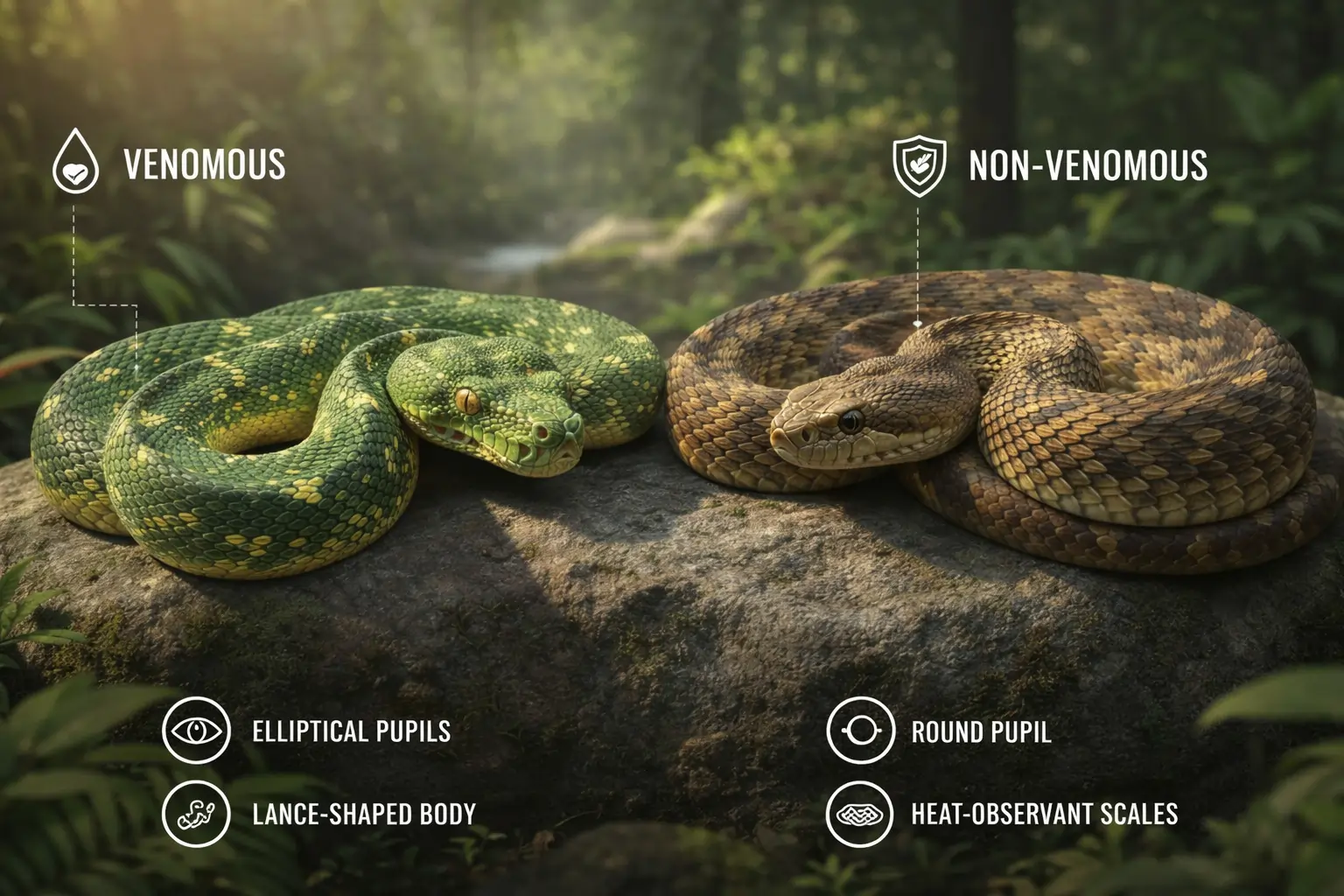
Knowing the difference between venomous and non-venomous species is important for safety. Most people cannot tell them apart easily, so it’s best to stay cautious around any unfamiliar reptile.
Venomous vs Non Venomous Comparison
Feature | Venomous Species | Non-Venomous Species
Purpose of venom – Kill or paralyze prey – No venom
Head shape – Often triangular – Usually rounded
Pupils – Often vertical slits – Usually round
Behavior – More defensive – Usually avoid humans
Bite danger – High risk – Lower risk
Example – Cobra, viper, rattlesnake – Python, garter snake, corn snake
This table shows general patterns, but some don’t fit every rule. Coral snakes, for instance, are highly venomous but have rounded heads.
How to Identify One (Simple Tips)
Here are practical ways to identify them safely:
Identification Tips
- Look at the head shape from a safe distance
- Notice the body size, thickness, and pattern
- Check the habitat type some prefer water while others stick to forests
- Look for distinctive features like rattles
- Avoid touching or provoking any wild reptile
Typical Behavior
Most aren’t aggressive at all. They usually bite only when they feel threatened or cornered. Think of it this way: they’re more scared of you than you are of them. Their first instinct is always to flee.
What to Do If You See One (Safety Steps)
If you spot one near your home or on a walk, follow these steps:
Safety Checklist
- Stay calm and stop moving suddenly
- Back away slowly without turning your back
- Don’t try to catch or kill it this is when most bites happen
- Keep children and pets away from the area
- If it enters your home call local wildlife control immediately
- Take a photo from a safe distance if identification is needed
Bite First Aid (Important)
If someone gets bitten, follow these steps immediately:
Action Steps
- Move away from the creature safely to avoid another bite
- Call emergency services right away don’t wait
- Keep the bitten limb still and below heart level if possible
- Remove tight clothing jewelry or watches before swelling starts
- Do not cut the wound or try to suck out venom
- Avoid applying ice or a tourniquet these cause more harm
- Try to remember what it looked like for medical staff
The most important rule is to get medical help quickly, because venom spreads fast through the body. Modern antivenoms work remarkably well when administered promptly.
Are They Dangerous?
Here’s the truth: most aren’t dangerous to humans. Only a small percentage, about 15% of all species are venomous, and even fewer pose serious threats to people.
Why Bites Happen
They bite mainly because they feel threatened, they’re protecting their territory, or someone startled them. Give them space, and you’ll dramatically reduce your risk of getting bitten. The data shows that most bites occur when people try to handle or kill them.
How to Prevent Them Near Your Home
Want to keep them away from your property? Try these simple steps:
Prevention Tips
- Keep grass short and remove wood piles where they might hide
- Seal gaps in walls, foundations, and under doors
- Remove food sources such as rodents no food means they won’t stick around
- Keep outdoor areas clean and clutter free
- Store firewood away from the house
- Trim vegetation near your home’s foundation
These steps can significantly reduce encounters around your home. You’re making your property less attractive by removing hiding spots and food sources.
Habitat & Distribution
These reptiles live in many habitats, including forests, deserts, wetlands, grasslands, and urban areas. Each environment supports different species that have adapted to those conditions.
Common Habitats
Habitat | Common Species
Forest – Pythons, tree snakes, green snakes
Desert – Rattlesnakes, sidewinders, vipers
Wetlands – Water snakes, cottonmouths, sea snakes
Grasslands – Garter snakes, racers, hognose snakes
Urban – Rat snakes, garter snakes, king snakes
Some are habitat specialists while others adapt to multiple environments. Garter snakes, for instance, appear almost anywhere from city parks to mountain meadows.
Symbolism and Cultural Meaning
Across cultures the snake represents many things in history and religion. They often symbolize rebirth (because of skin shedding) wisdom, danger transformation or healing. For example the medical symbol the Rod of Asclepius includes one wrapped around a staff representing healing and medicine.
In some traditions, they’re revered as sacred animals. In others they’re seen as symbols of evil or danger. This duality reflects humanity’s complicated relationship with these creatures.
Common Myths (Truth vs False)
Myth | Reality
All of them are venomous – False. Most are completely harmless
They chase humans – False. They usually flee as fast as possible
Bites are always deadly – False. Most bites can be treated successfully
Babies are more dangerous – False. Venom levels are similar to adults
They’re slimy – False. Their skin is dry and smooth
Milk snakes drink cow’s milk – False. Pure folklore with no truth to it
Summary: What You Should Remember
These reptiles are common worldwide and mostly harmless. Most bites happen when people try to touch or kill them so just don’t. Avoiding them and knowing basic safety can prevent almost all dangerous encounters. If someone gets bitten, seek emergency help immediately.
They play important roles in ecosystems by controlling rodent populations and serving as prey for larger animals. Understanding their behavior helps turn fear into informed respect.
FAQs (Frequently Asked Questions)
- Are all of them dangerous?
No. Only a small percentage are venomous. Most are harmless and want to avoid you as much as you want to avoid them.
- How can I tell if one is venomous?
It’s hard to tell without proper training. The safest option is to keep your distance and contact wildlife experts if identification is needed.
- What should I do if I see one in my home?
Stay calm, keep your distance, and call a local wildlife removal service. They’ll handle it safely without putting you at risk.
- Can they bite through clothing?
Some venomous species can bite through thin clothing. Thick boots and jeans offer some protection, but avoidance is always the best strategy.
- Do they attack humans?
Most don’t attack unless threatened or provoked. Unprovoked attacks are extremely rare. They’d rather escape than fight.
- How fast can they move?
Some can move very fast in short bursts black mambas can hit 12 mph but most are actually slower than you’d think. Even fast ones can’t maintain top speed for long.
- What do they eat?
Diets vary by species: rodents, birds, eggs, insects, fish, frogs, and other small animals. Larger ones might eat rabbits or young deer.
- How long do they live?
Lifespan ranges from 5–10 years in small species to 20–30+ years in larger ones like pythons and boas. Wild individuals typically have shorter lifespans than captive ones.
- Should I kill one if I see it on my property?
No. It’s often illegal, dangerous for you, and unnecessary. Call wildlife removal if it’s in a problematic spot.
- Are they good pets?
With proper care and species selection, they can make rewarding pets. Beginners should start with docile species like corn snakes or ball pythons.