
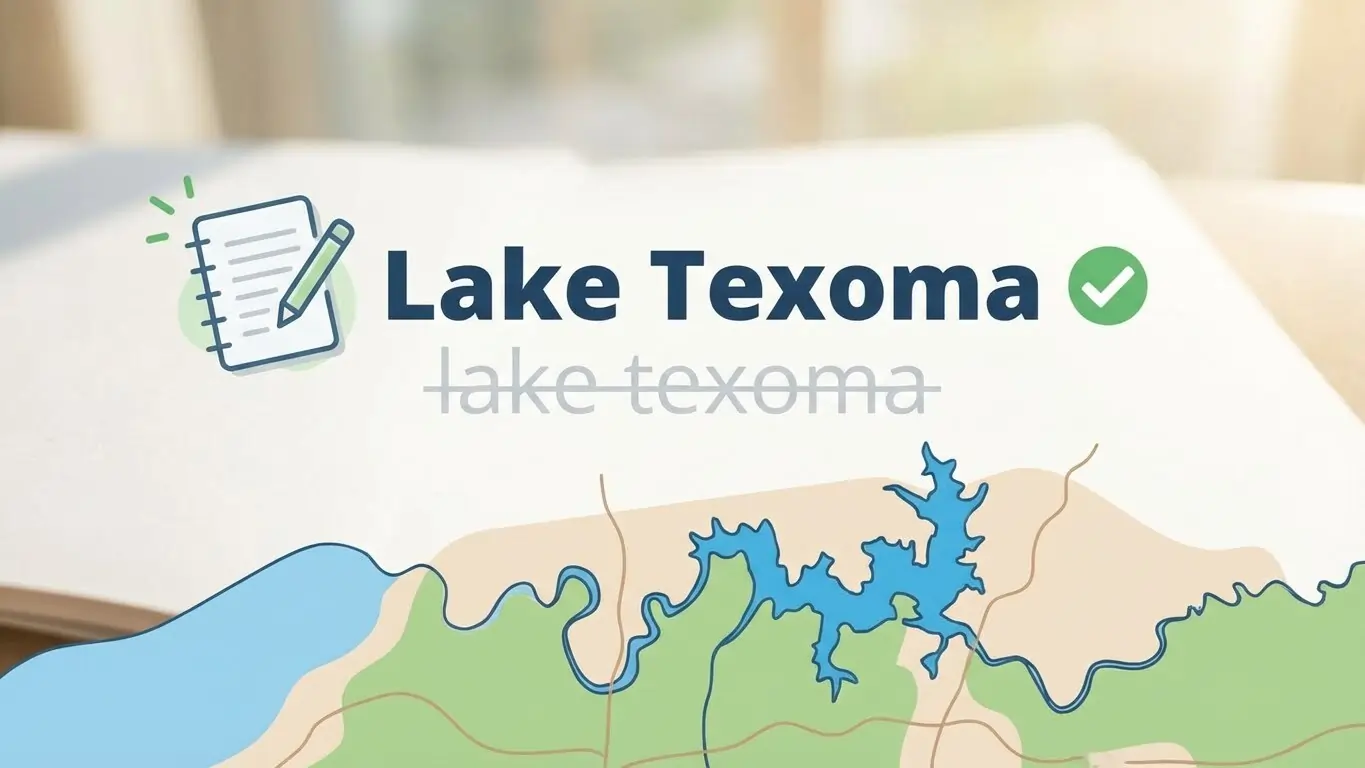
You know that moment when you’re typing a place name and your fingers just… pause? Lake Texoma should be capitalized yet it still confuses a lot of writers. It feels like such a small detail whether to capitalize both words or just one. However here’s the truth: getting it wrong can quietly chip away at your credibility.
That’s why we’re diving into why Lake Texoma should be capitalized. We’ll break down the rules, show you what works (and what doesn’t) and give you tips you can start using right now whether you’re writing an essay, a blog post or anything in between.
Why Writers Get Confused About “Lake Texoma”
The word “lake” feels ordinary right? It’s just a body of water. So it makes sense that many people think it should stay lowercase. But once a geographic feature gets an official name the rules shift.
Plus teachers, editors and even search engines notice when your capitalization bounces around. It makes your content look rushed even if everything else is spot on. Once you nail this rule you’ll write with way more confidence.
Should Lake Texoma Be Capitalized? (Quick Answer)
Yes. Always capitalize Lake Texoma when you’re talking about the actual lake.
Use it correctly in:
- School papers and essays
- Blog posts and web articles
- Headings and titles
- Marketing materials and travel guides
Since Lake Texoma is a proper noun, English grammar requires you to capitalize both words. Simple as that.
1: Lake Texoma Is a Proper Noun
Proper nouns name specific places, people, or things. Lake Texoma points to one exact spot on the map, so it’s definitely a proper noun.
That means capitalization isn’t optional.
Example:
✅ We visited Lake Texoma last summer.
❌ We visited lake texoma last summer.
Once you see it as a named place, the rule clicks into place pretty quickly.
2: Only Capitalize “Lake” When It’s Part of the Name
This is where most mistakes happen. Let me break it down.
Capitalize “Lake” when:
- It’s paired with the official name
- You’re referring to that specific lake
Example:
✔ Fishing at Lake Texoma is popular all year long.
Don’t capitalize “lake” when:
- You’re speaking generally
- No specific name follows
Example:
✔ The lake was packed last weekend.
So the deciding factor is always whether you’re using the actual name or not.
3: Don’t Mix Your Capitalization
Switching back and forth between capitalized and lowercase versions? That’s a quick way to confuse readers and hurt your credibility. It also tells editors (and search engines) that you didn’t proofread carefully.
Incorrect Example:
Lake Texoma is beautiful. Many people visit Lake Texoma each year.
Correct Example:
Lake Texoma is beautiful. Many people visit Lake Texoma each year.
Consistency isn’t just nice to have, it’s a must for professional writing.
4: Titles and Headings Follow the Same Rule
Some writers think headings are free for all. They’re not. Proper nouns stay capitalized no matter where they appear.
Correct Titles:
- Best Fishing Spots at Lake Texoma
- A Complete Travel Guide to Lake Texoma
Incorrect Titles:
- Best Fishing Spots at lake texoma
Getting this right in your headings makes everything feel more polished and professional.
5: Academic and Professional Writing Demands Precision
In school papers, grammar mistakes can cost you points. In professional settings, they can cost you credibility. It’s that straightforward.
So make sure you’re using Lake Texoma correctly in:
- Essays and reports
- Research papers
- Presentations and proposals
Even if your research is solid, sloppy grammar makes you look careless.
6: SEO Content Works Better with Correct Capitalization
Now capitalization alone won’t skyrocket your search rankings. But it does support user trust and readability and those things matter a lot.
When you capitalize Lake Texoma correctly, you:
- Improve the reader’s experience
- Keep people on your page longer
- Signal that your content is high-quality
For SEO writing, always capitalize Lake Texoma in your headings, body text and even your meta descriptions.
7: Official Sources Always Use “Lake Texoma”
Government websites, tourism boards and educational resources consistently write it as Lake Texoma. That’s not a coincidence, it’s the standardized, accepted form.
When you follow official naming conventions, you’re aligning yourself with trusted sources. That builds authority and trust with your readers.
Correct vs. Incorrect Usage Examples
Correct:
- Lake Texoma attracts visitors all year round.
- Many anglers love fishing at Lake Texoma.
- Weather at Lake Texoma can shift pretty fast.
Incorrect:
- Lake Texoma attracts visitors all year round.
- Many anglers love fishing at Lake Texoma.
- Weather at lake Texoma can shift pretty fast.
Each incorrect example breaks basic proper noun rules. Don’t let that be you.
Quick Reference Table
Writing Situation |
Correct Form |
|
Official name |
Lake Texoma |
| General reference |
the lake |
|
Essays and exams |
Lake Texoma |
| Blog posts |
Lake Texoma |
|
Titles and headings |
Lake Texoma |
Keep this table handy when you’re editing your work.
Common Mistakes Writers Still Make
Even though the rule is pretty straightforward, people still mess it up. Here’s what to watch out for.
1. Writing “lake texoma” in Lowercase
One of the most frequent mistakes is writing “lake texoma” entirely in lowercase. This usually happens because writers treat the word lake as a generic term. However, when lake appears as part of an official name, it becomes part of a proper noun.
For example, writing “We visited lake texoma last summer” is grammatically incorrect. Since you are naming a specific place, both words must be capitalized. This mistake often appears in blog posts, social media captions, and casual writing, but grammar rules still apply in all formats.
2. Capitalizing Only One Word
Another common error is capitalizing just one part of the name, such as “Lake texoma” or “lake Texoma.” This inconsistency usually comes from uncertainty about which word deserves capitalization.
In reality, both words are part of the official name. Therefore, both must be capitalized together. Mixing capitalization styles within the same phrase makes the writing look careless and unedited.
3. Being Inconsistent Throughout the Article
Many writers start correctly with Lake Texoma and then switch to lake texoma later in the same article. This inconsistency confuses readers and weakens trust.
Consistency matters, especially in academic, professional, and SEO-focused content. Search engines and readers both expect uniform usage. As a result, switching capitalization styles can make content appear low quality, even if the information itself is accurate.
4. Capitalizing “Lake” When It’s Used Generically
Some writers go too far in the opposite direction by capitalizing lake even when no specific name is used. For example, writing “We relaxed by the Lake” is incorrect unless the lake’s name follows.
When lake is used as a common noun without a proper name, it should remain lowercase. Over-capitalization is just as incorrect as under-capitalization and shows a misunderstanding of grammar rules.
5. Ignoring Capitalization Rules in Headlines and Titles
Another mistake occurs in titles and headings. Some writers assume that headlines follow different rules or that lowercase looks more “stylish.” However, proper nouns must always remain capitalized, even in creative or informal headings.
For example, “Best Fishing Spots at lake Texoma” looks unprofessional and grammatically incorrect. Headlines should reinforce authority, not weaken it.
6. Assuming Capitalization Doesn’t Affect SEO or Credibility
Many writers believe capitalization has no real impact beyond grammar. While it may not directly control rankings, it strongly affects readability, trust, and user experience.
Incorrect capitalization can make content look rushed or unreliable. As a result, readers may leave the page sooner or question the accuracy of the information. Over time, this can indirectly affect SEO performance.
Avoid these mistakes and your writing instantly levels up.
How to Apply This Rule Right Now
- Always capitalize Lake Texoma when you’re naming it
- Use lowercase “lake” only when you’re speaking generally
- Stay consistent from start to finish
- Double-check your headings and titles
Follow these steps, and you’ll never second-guess yourself again.
Final Thought
Most of these mistakes come from hesitation or misunderstanding, not carelessness. Fortunately, the fix is simple. Remember this rule: if you are naming the place, capitalize it.